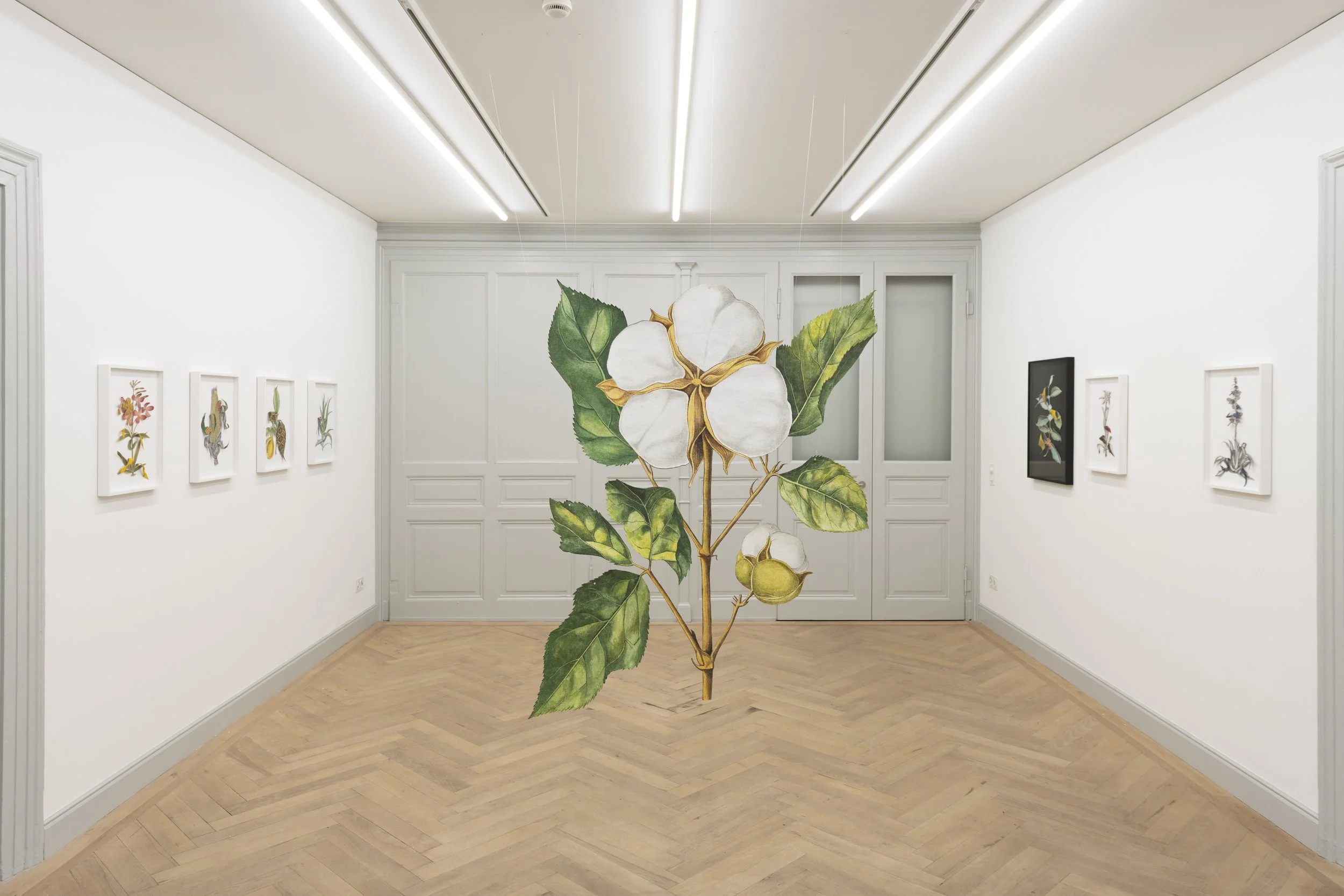

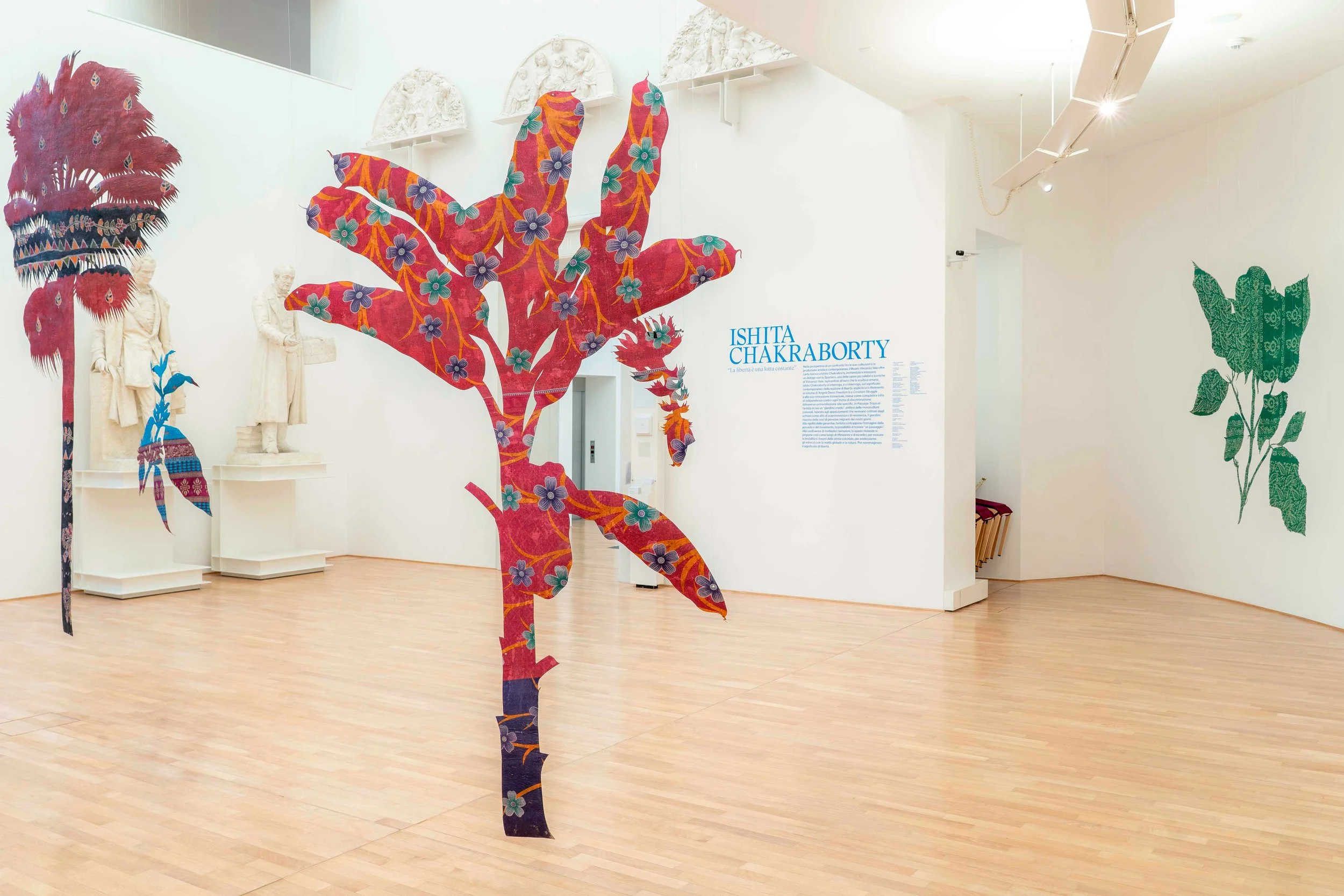
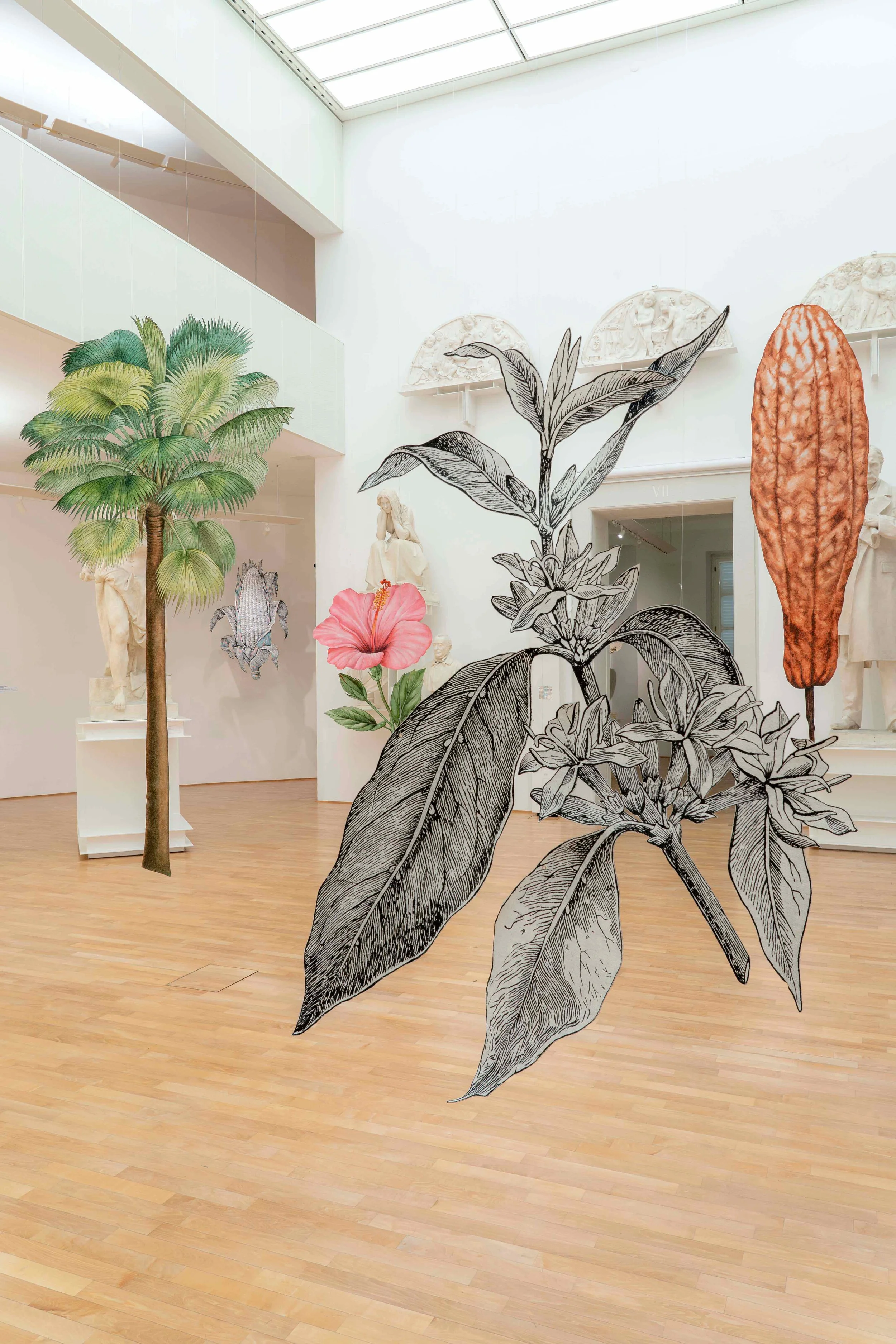
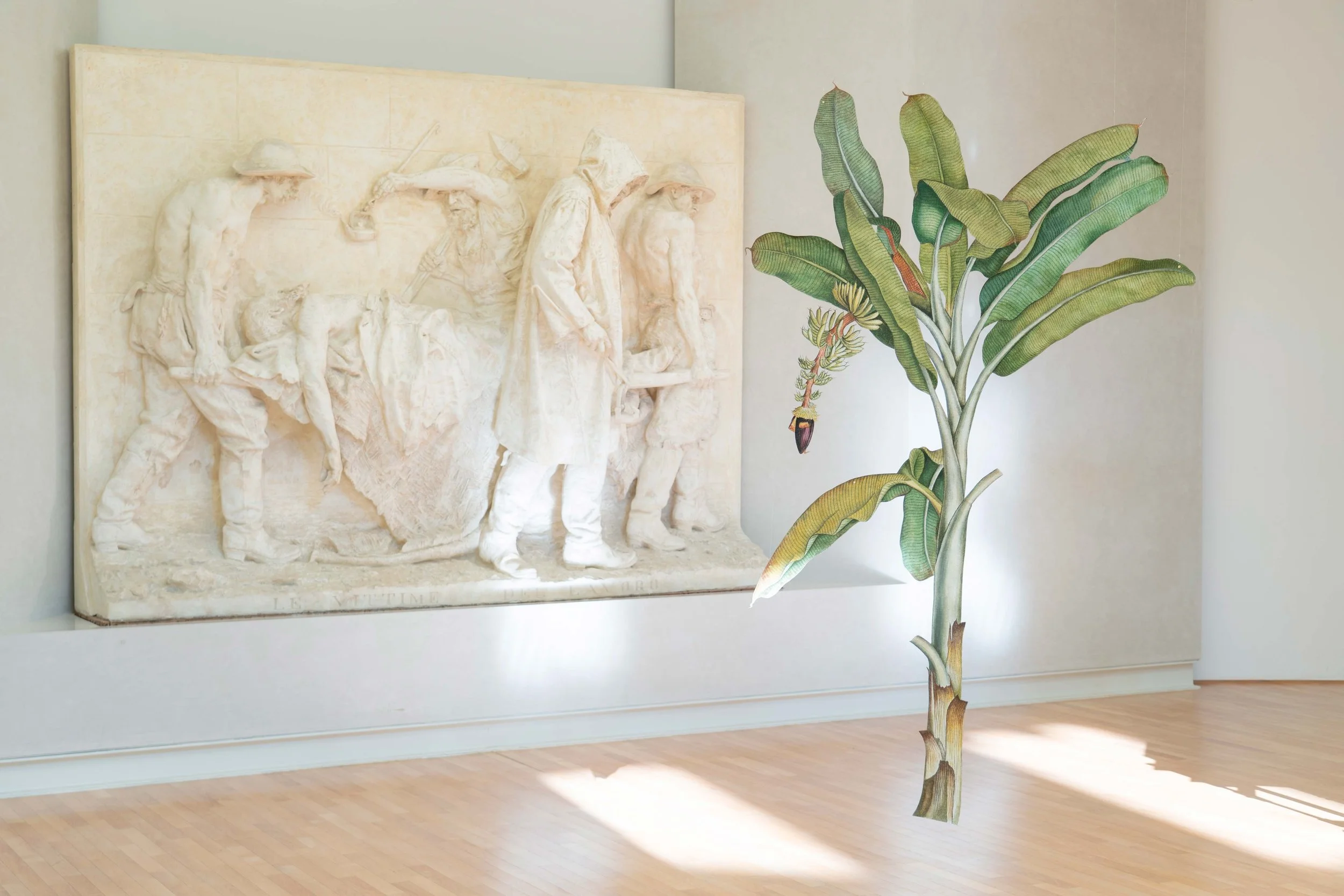
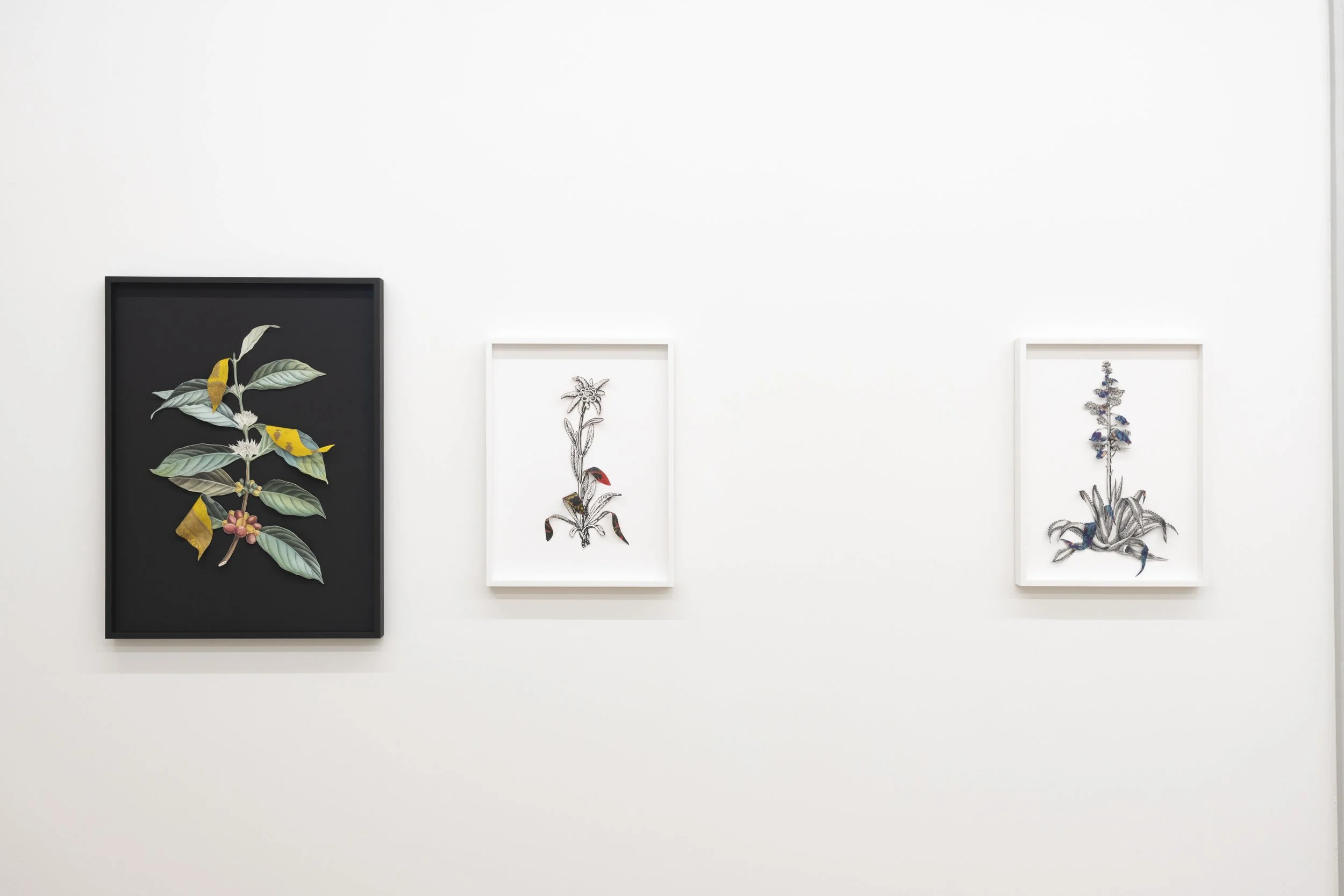
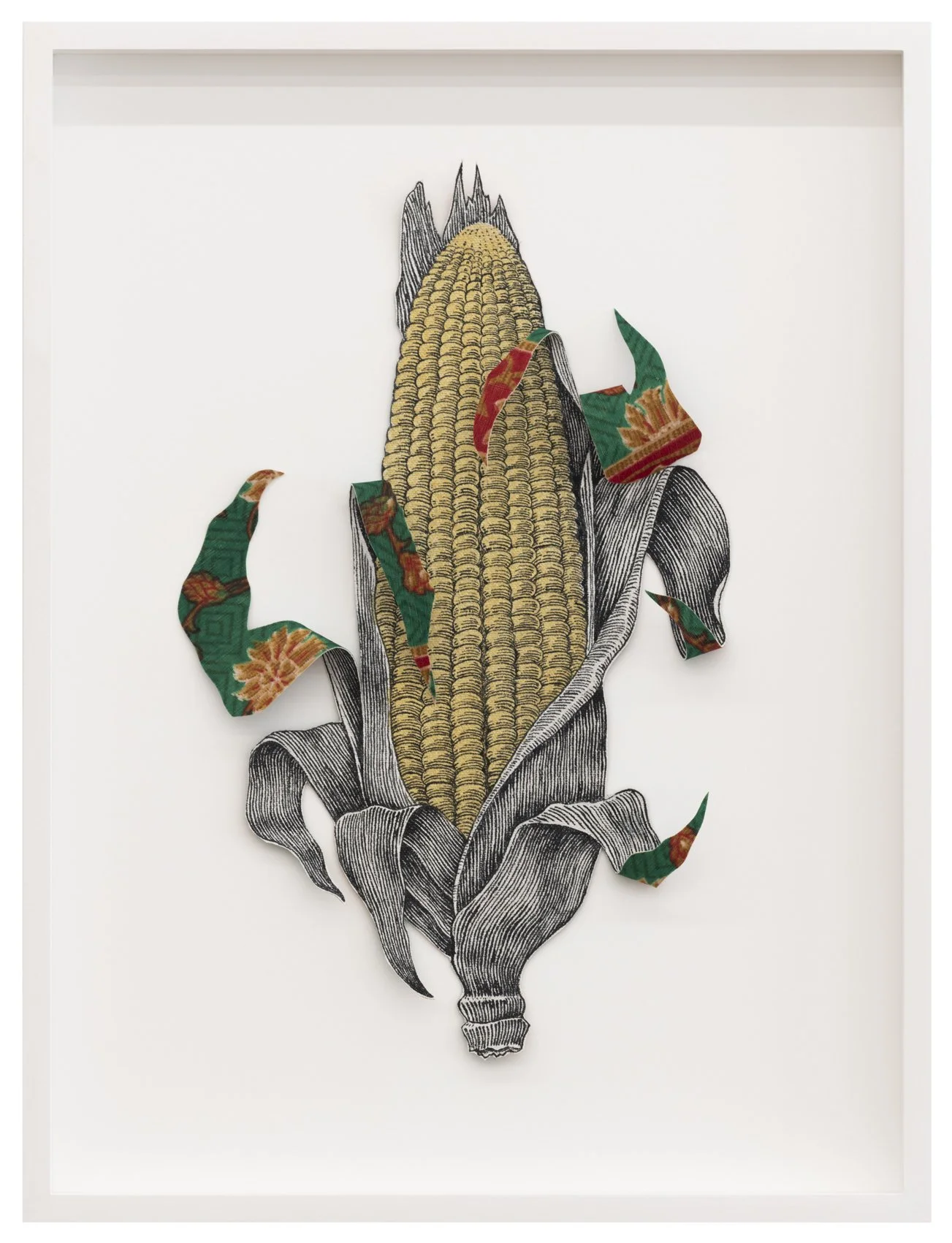
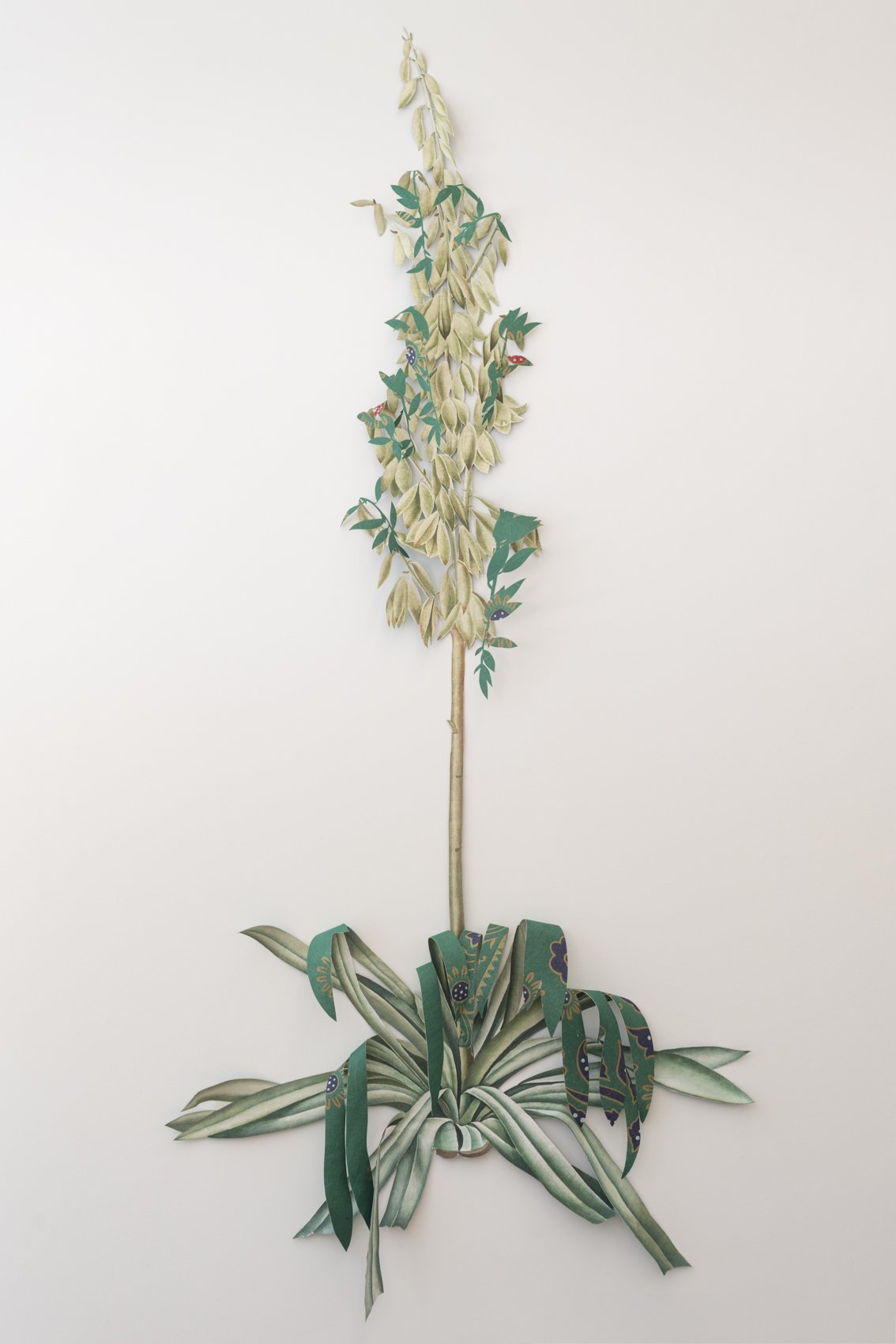
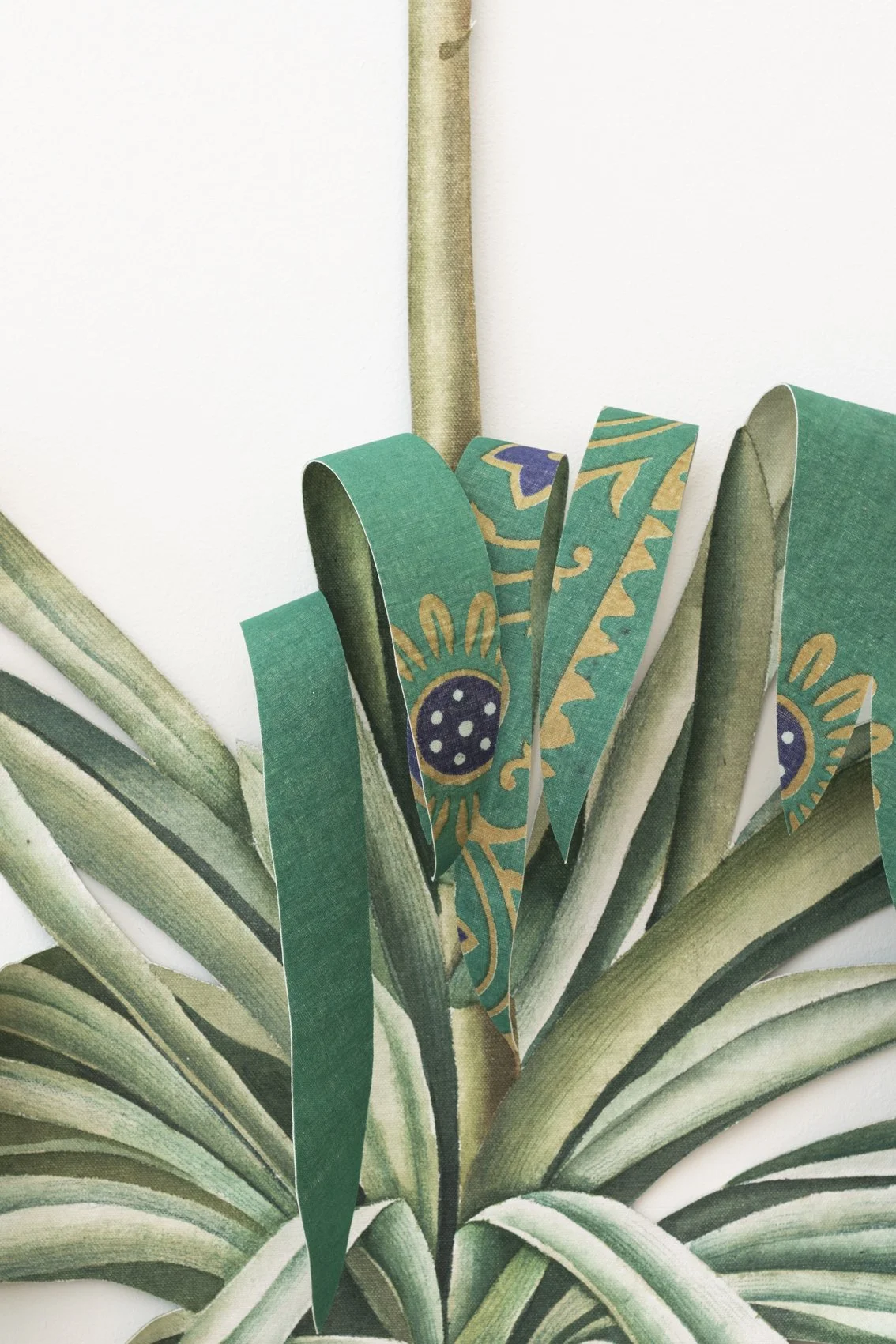
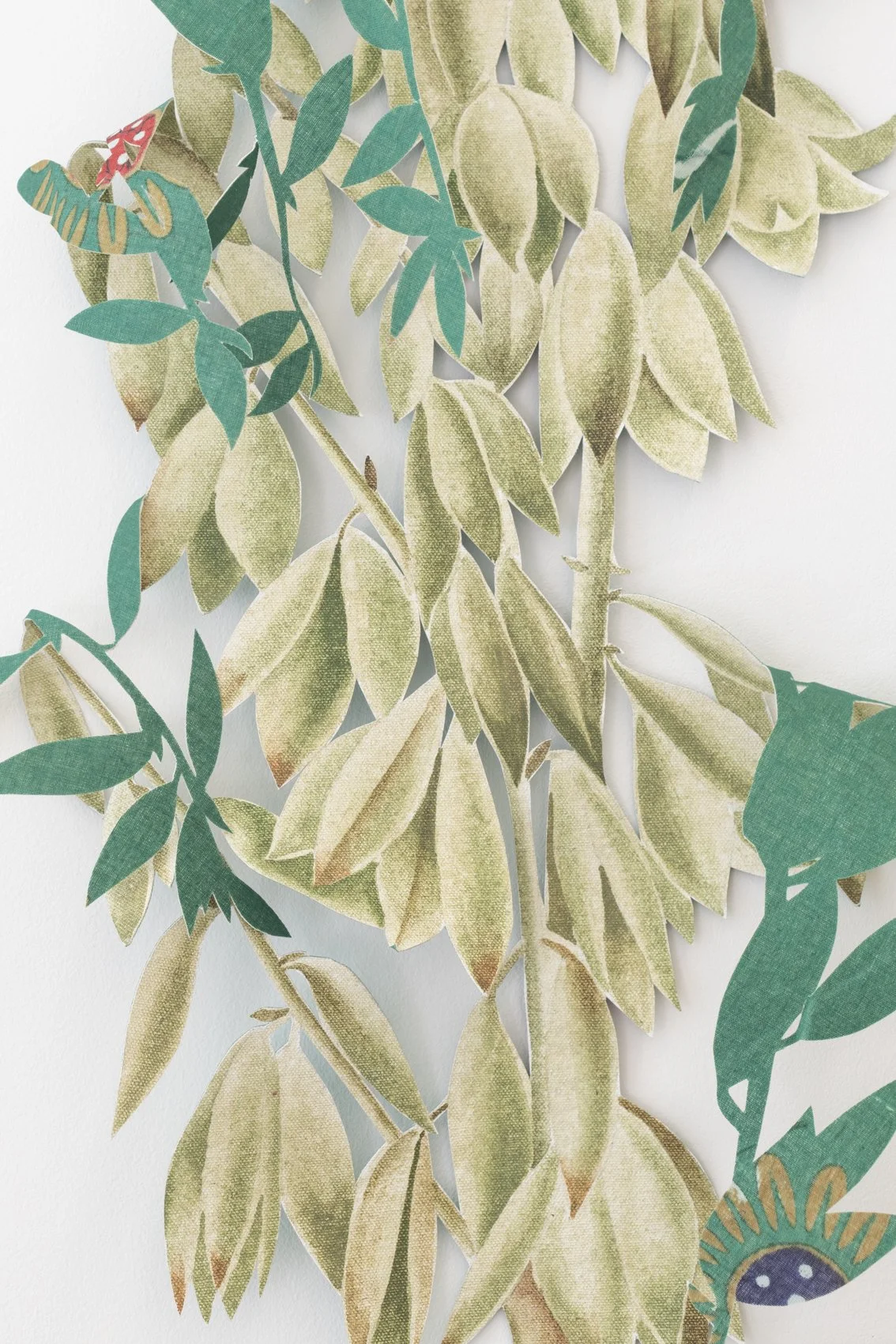
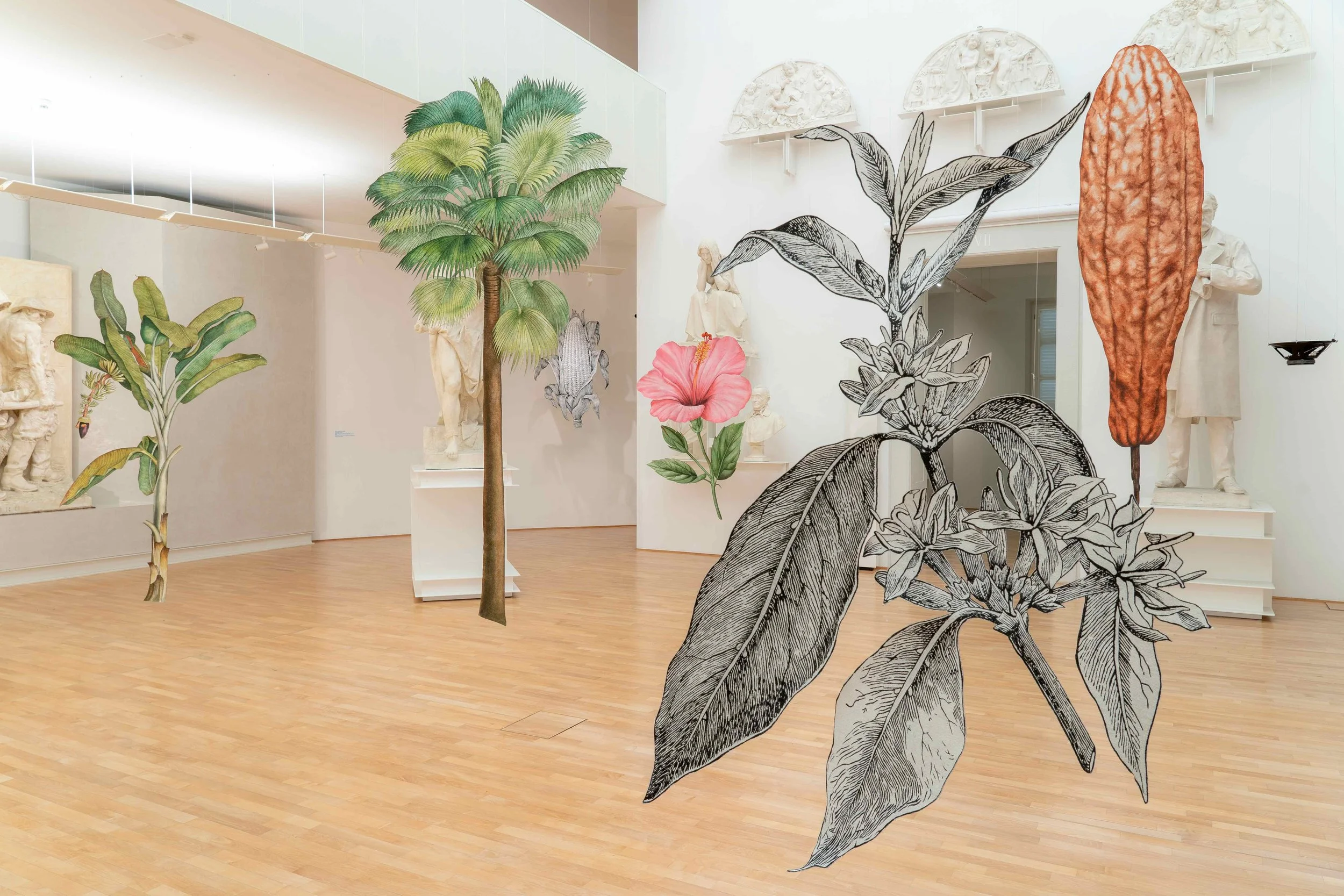
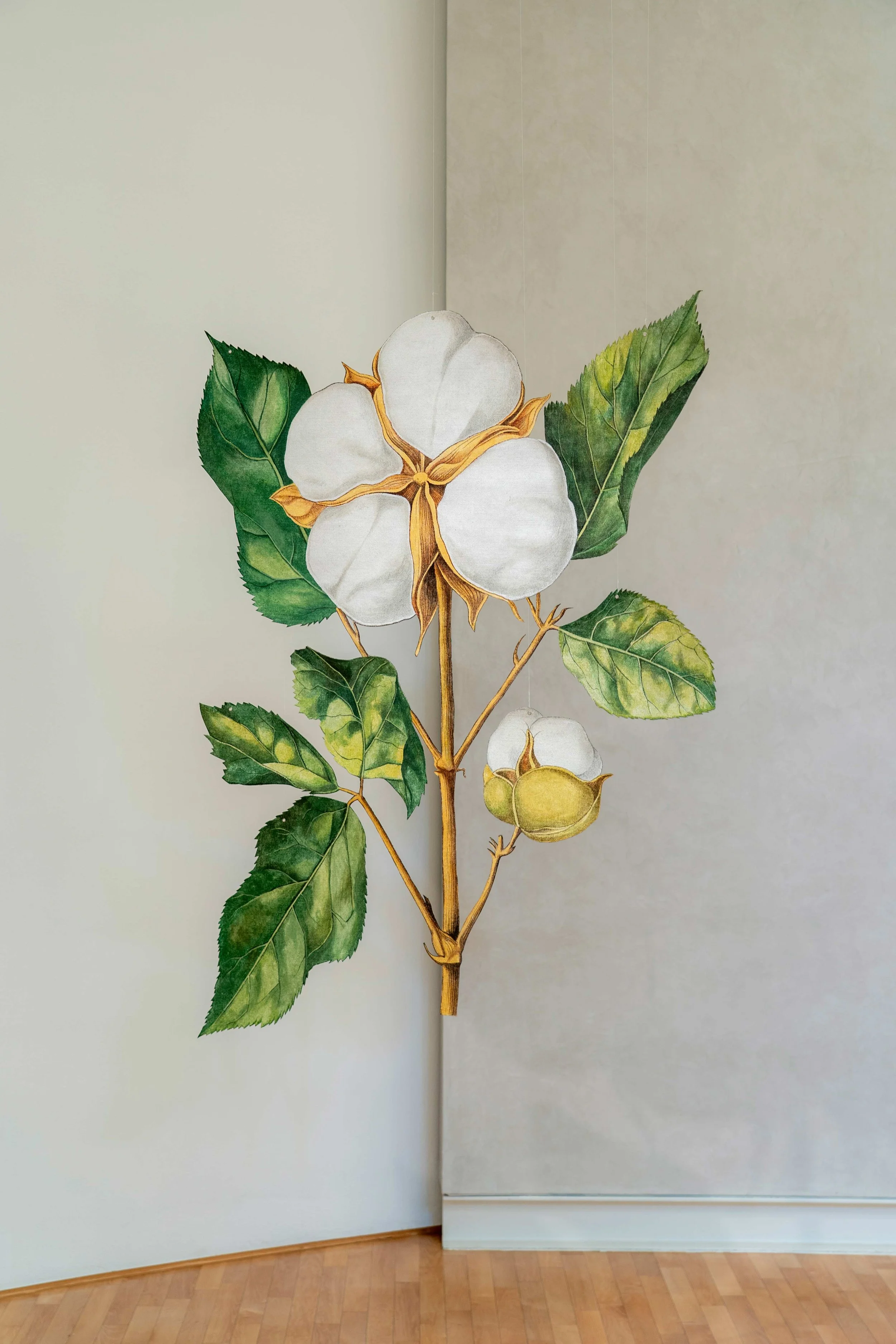
Medium: Acrylic on Canvas, pasted on Indian Chappa cotton Saree Fabric I Size: Variable I Year: 2025
Where the Wild Things Roam — is a series of plant cutouts painted on canvas with acrylic and pasted on cotton saree fabrics from India. The title of the artwork explores how the migration of plants has served as a political tool for European settlers, driving economic growth while reshaping ecosystems and societal structures in colonized regions. At the heart of plant migration is the concept of commodification. This ambition was rooted in a desire to cultivate cash crops—such as sugar, coffee, and cotton—that would feed into a burgeoning global economy. The transfer of these crops from their native environments to new colonies was not merely a botanical venture; it was an assertion of control and dominance over both the land and its indigenous populations. The role of botany as a scientific discipline was closely aligned with imperial ambitions. European botanists were often dispatched to catalogue and transport new species back to their home countries, where they would be cultivated for economic gain. The establishment of botanical gardens in Europe served not only as repositories of plant diversity but also as symbols of national pride and scientific advancement.
Border imperialism and war play a crucial role in stabilizing the accumulation of capital by expanding and deepening the exploitation of labour and natural resources. For generations, inequality has had a significant impact on the climate emergency for racial communities. Therefore, "Climate justice can't happen without racial justice".
My project focuses on botanical illustrations made from plant cutouts and saree fabrics, representing the movement of plants, which is linked to colonial history.
These cutouts are attached to the canvas like a herbarium collection, showing how plants have been taken from their original environments and used in new cultural contexts. Interestingly, some of these exotic plants have adapted and even become part of national identities over time. For example, the Edelweiss is believed to have migrated from the high plateaus of the Himalayas and Siberia to Europe, Switzerland, and the Alps, likely during the Quaternary ice ages. Another plant, Geraniums, for example, originally from South Africa, was introduced to Europe in the 17th century by Dutch and British sailors. They became popular in botanical gardens and among wealthy collectors before gradually making their way to rural regions, such as the Bernese Oberland in Switzerland, by the 18th and 19th centuries. The interesting process for me was making the cutouts - it was like cutting them out of context, much like cutting out images from a science or history book. It serves as a backbone of decolonizing perspectives. It emphasizes the intersection of these visuals with ecofeminism, reflecting on the complex relationships between culture, nature, and gender in a postcolonial context—the role of women in plantations and agriculture in the Global South.
I started working with sarees last year; these Chapa prints on the saree are typical of Bengal regions, Bihar state, and Bangladesh. Chapa means Print. It's an inexpensive cotton fabric, bold in colour, used mainly by women in rural and semi-urban areas or at home in these regions. For me, it has another importance. Hence, they are part of the post-colonial female bodies. The prints are often floral, covering the brown skin. While thinking of the reparation of past slavery and indentured labour there, very little has been done.
At a glance, these works appear very intriguing, drawing you closer and allowing you to discover the ethnic saree fabrics, which are an inseparable part of these plants. The dominance of scientific knowledge has even erased much of the native and indigenous knowledge, and local names. Scientific knowledge has been seen as superior to women's domain. So, I try to bring decolonial perspectives to question the dominant Western gaze through an ecofeminist lens.