Please do not copy, reproduce, or distribute this content without permission.
Lama Altakruri (b.Abu Dhabi 1982) is an artist based in Ramallah, Palestine. Lama was raised in Bahrain before moving to Palestine in 1994. Lama is an artist and educator. Lama has been travelling and has immigrated to many places around the world. She has been speaking about what it means to be a Palestinian today and travel. @lamaaltakruri (*Please do not copy or download content without permission.
Farid Alizai was born in Balochistan, Pakistan, to Afghan parents who had fled Afghanistan during the Soviet invasion of the 1970s and 1980s. His life has been shaped by successive histories of displacement: first through his parents’ migration, and later through his own forced departure from Balochistan as a result of ongoing political instability and persecution. Today, he lives in Switzerland as an asylum seeker. Farid’s knowledge has been acquired not through institutional education but through lived experience, migration, and survival. Moving across borders and linguistic territories, he has learned to navigate multiple cultural worlds and now speaks more than six languages. His skills as a cook, builder, and maker reflect forms of embodied knowledge that are often overlooked within dominant narratives of expertise and education.
Françoise Vergès is a French political scientist, historian, film producer, independent curator, activist, and public educator. Her work focuses on postcolonial studies and decolonial feminism. Vergès was born in Paris and grew up in Réunion and Algeria before returning to Paris to study and become a journalist. Mrs. Verges's journey, books, and lectures inspired me so much, and last year, I had the opportunity to speak to her about her memories with Banana plants on La Réunion Island.
Azad Colemêrg was born in the Kurdish region of southeastern Turkey, where he worked as a teacher of history and geography. Forced to leave his homeland due to political persecution and ongoing instability, he now lives in Switzerland as a political asylum seeker. Alongside his pedagogical practice, Azad is active as a performance artist and has presented his work at venues including the ACT Performance Festival and the Johann Jacobs Museum. In this project, Azad recounts memories from his childhood marked by the presence of violence along the militarized borderlands of Kurdistan. Speaking in his mother tongue, Kurdish, he evokes the sounds of exploding landmines and military helicopters that shaped the acoustic landscape of his youth. His testimony intertwines personal memory with collective histories of displacement, conflict, and survival, transforming lived experience into an act of witnessing and resistance.
About Whispering Benches, a sculptural public art installation:
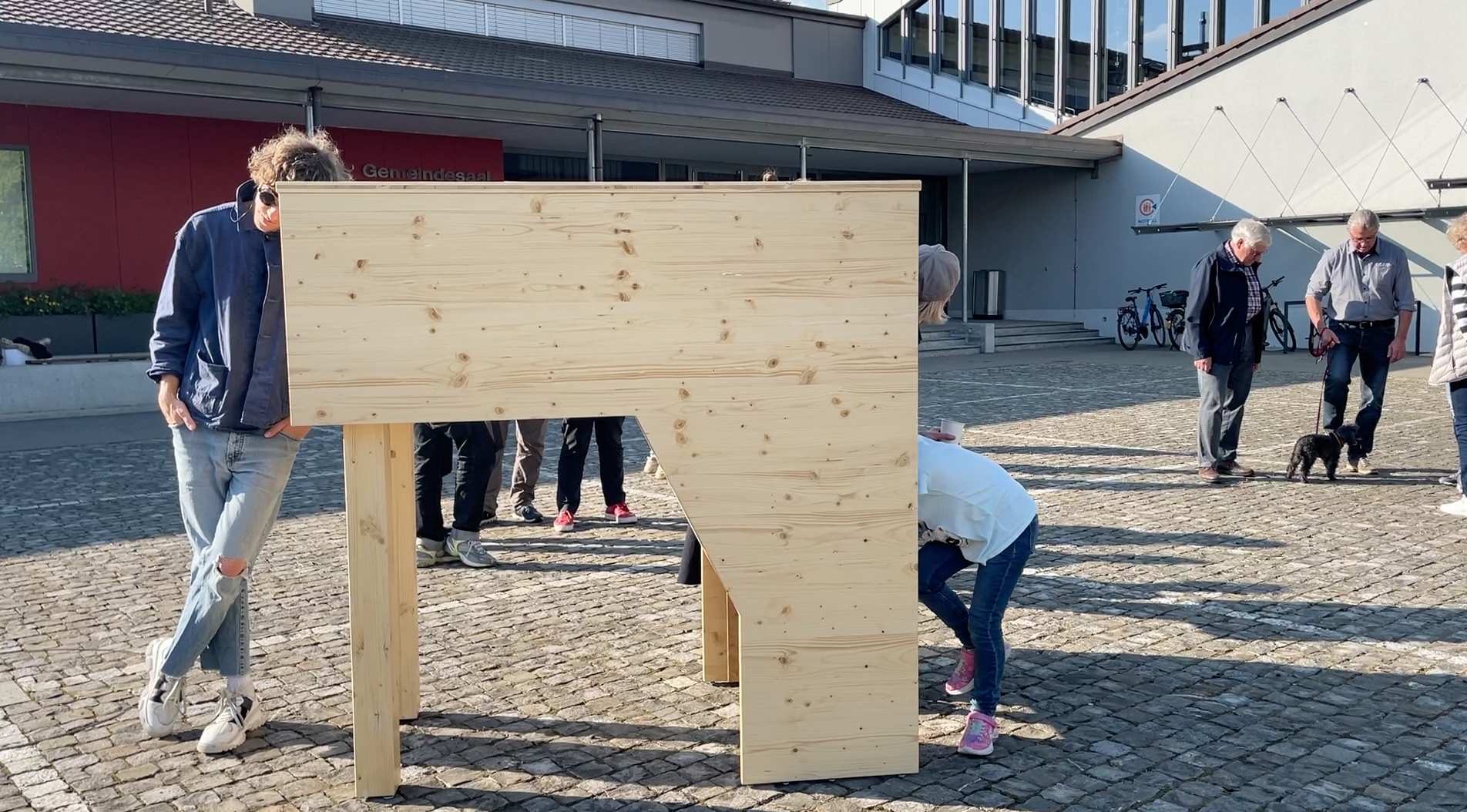
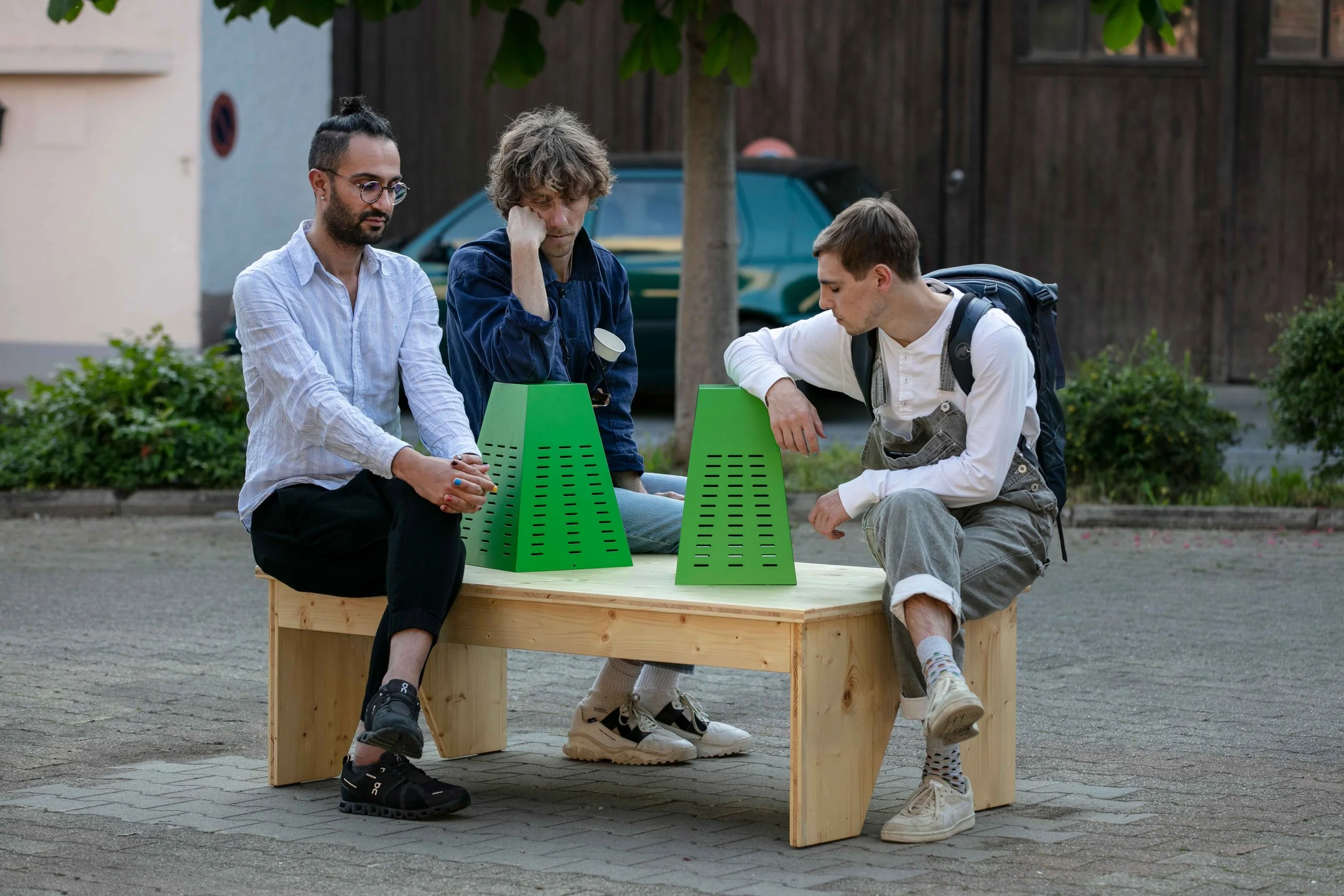
Whispering Benches is a sculptural public art installation that seeks to amplify voices often rendered unheard within contemporary society. The project explores listening as a transformative and political act—one that engages questions of power, colonial legacies, migration, and social belonging. At its core, the work invites audiences to reconsider listening not as a passive gesture but as a reciprocal and symbiotic practice capable of generating empathy, connection, and collective responsibility.
Storytelling, poetry, and song form the foundation of the project. Through the protagonists’ own words and voices, participants share experiences of displacement, migration, alienation from home and family, and the challenges of adapting to new environments. These narratives bear witness to lives shaped by climate migration, war, environmental catastrophe, and political oppression, offering intimate perspectives on broader global realities.
The project takes its inspiration from Unfortunately, It Was Paradise, the title of Mahmoud Darwish’s bilingual anthology of poetry. The notion of “Paradise” as a place of security, prosperity, and fulfilment resonates strongly with perceptions of Switzerland, which is frequently imagined—both internationally and through the lens of its tourism industry—as an idyllic destination. Friends and family in India often remark that I live in “Paradise.” Yet this seemingly innocent assumption has occupied me since my arrival in Switzerland, revealing the complex contradictions embedded within migrant experiences. The title therefore functions as an ironic reflection on the distance between imagined and lived realities, a tension familiar to many immigrants navigating questions of belonging, exclusion, and identity.
This inquiry led me to collaborate with inmates at JVA Cazis Tignez, a closed correctional facility in Graubünden. What began as an individual artistic investigation gradually evolved into a collective and collaborative endeavour. The benches were sustainably produced in the prison’s woodworking workshops, transforming the project into a shared process of making, dialogue, and exchange. My thinking was informed by the writings of Angela Davis, particularly her critique of the prison as a social institution. In Are Prisons Obsolete?, Davis argues that prisons function not simply as places of punishment but as mechanisms that remove complex social problems from public view. Rather than addressing the structural causes of inequality, poverty, racism, displacement, or violence, societies often rely on incarceration to manage those who are deemed undesirable or disposable. Davis describes this phenomenon as a “prison industrial complex,” a system that normalizes imprisonment while obscuring the broader political and economic conditions that produce incarceration. Her work challenges us to consider prisons not as isolated institutions but as reflections of the inequalities embedded within society itself.
Conceived during the social isolation of the pandemic, Whispering Benches emerged in response to the fragmentation and distance that characterised the period. The work consists of sculptural benches equipped with integrated audio installations, placed in public spaces, that enable visitors to encounter fragments of other lives through listening. Situated particularly within small Swiss villages, the benches create unexpected moments of connection, inviting passers-by to engage with stories that might otherwise remain unheard. For me, it was essential that the sculptures were produced within this context. The project became an opportunity to create a platform where often-unheard voices could enter public space in unexpected ways. The benches carry not only recorded stories but also the traces of the hands that built them, embodying relationships between freedom and confinement, mobility and immobility, visibility and erasure. Through this collaboration, Whispering Benches asks audiences to listen not only to individual narratives but also to the social structures that shape whose stories are heard, whose movements are restricted, and whose lives remain hidden behind the walls of paradise.
Curated by Gianni Jetzer, the project was first presented across three locations in the Canton of Aargau—Möriken-Wildegg, Lengnau, and Baden. Yet the benches themselves remain migratory, conceived as objects that travel from place to place, carrying voices, memories, and experiences across geographical and social boundaries. As an evolving public art initiative, Whispering Benches functions as a community-building platform that relies on participation, interaction, and active engagement. Through its ongoing journey, the project seeks to cultivate dialogue, strengthen social bonds, and activate public space through shared acts of listening.
Please listen generously.
Artist:
Curator:
Gianni Jetzer
Special Thanks to:
Contributors:
-Ella Ronen
-Ali Reza
-Lama Altakruri
-Milena Petrovic
-Farid Alizai
-Azad Colemêrg
-Vandria Borari.
-Ayliz Baskin Huber
-Marshal Bhebhe
-Annabelle van Puijenbroek
-Françoise Vergès
Production:
JVA Cazis Tignez - Office of Corrections - Canton Graubünden in the in-house carpentry workshop.
Graphic Design:
Anirban Ghosh
Sound designer/ editor:
Stefan Bauer
Additional Support:
Claudia Spinelli, Kunstraum Baden
Cornelia Ackermann, Kunst Im Trudelhaus
Photo and Video Documentation:
Advisory and collaboration
Martina Huber, We are AIA, Zurich
Special thanks to:
Gemeindehaus Morieken-Wildegg.
Gemeindehaus Lengnau.
Kunst Im Trudelhaus Baden.
Aargauer Kunsthaus.
The project is supported by:
Pro Helvetia, Swiss Arts Council.
Kulturstiftung der Credit Suisse Aargau
Hans und Lina Blattner Stiftung
LEBENSRAUM AARGAU